External engagement · anonymised
Running the chain on a real engagement
The diagnostic pipeline, used end-to-end on a live external piece of work — not a demo.
- 5
- voices in the debate
- 3
- specialist reviews
- 0
- client details shown
The idea
intake brief
Research
live market evidence · cited
Five voices · structured disagreement
The Builder
can we make it?
The Edge Thinker
the non-obvious play
The Black Hat
what kills it
The Customer
would I pay? · veto
The Historian
what happened before
Six lenses · each within its remit
Commercial strategy
viability
Finance
the maths
Technical
feasibility
Distribution
reach & channels
Legal & regulatory
what's allowed
Customer experience
the actual user
Strategist
holds the tensions into a verdict
Report
a person decides
The diagnostic chain isn't only something I run on my own ideas. I used it end-to-end on a real external engagement — a solo founder repositioning a direct-to-audience personal brand, who needed a clear-eyed relaunch strategy. It was run as a real, commercial piece of work with real stakes on the other side, not a demonstration.
This page is deliberately thin on specifics. The whole point of the system is that the contents stay the client's — names, sector, and the actual findings stay out. What I can show is the shape of the work and the reasoning behind it.
What the engagement needed
A founder with a genuine audience but an unclear path: which platforms to lean on and which were too volatile to build on, how to position, where the real commercial floor sat, and how to sequence a relaunch without betting everything on a single channel. The kind of decision where one confident answer is worth less than a well-argued set of trade-offs.
What the chain produced
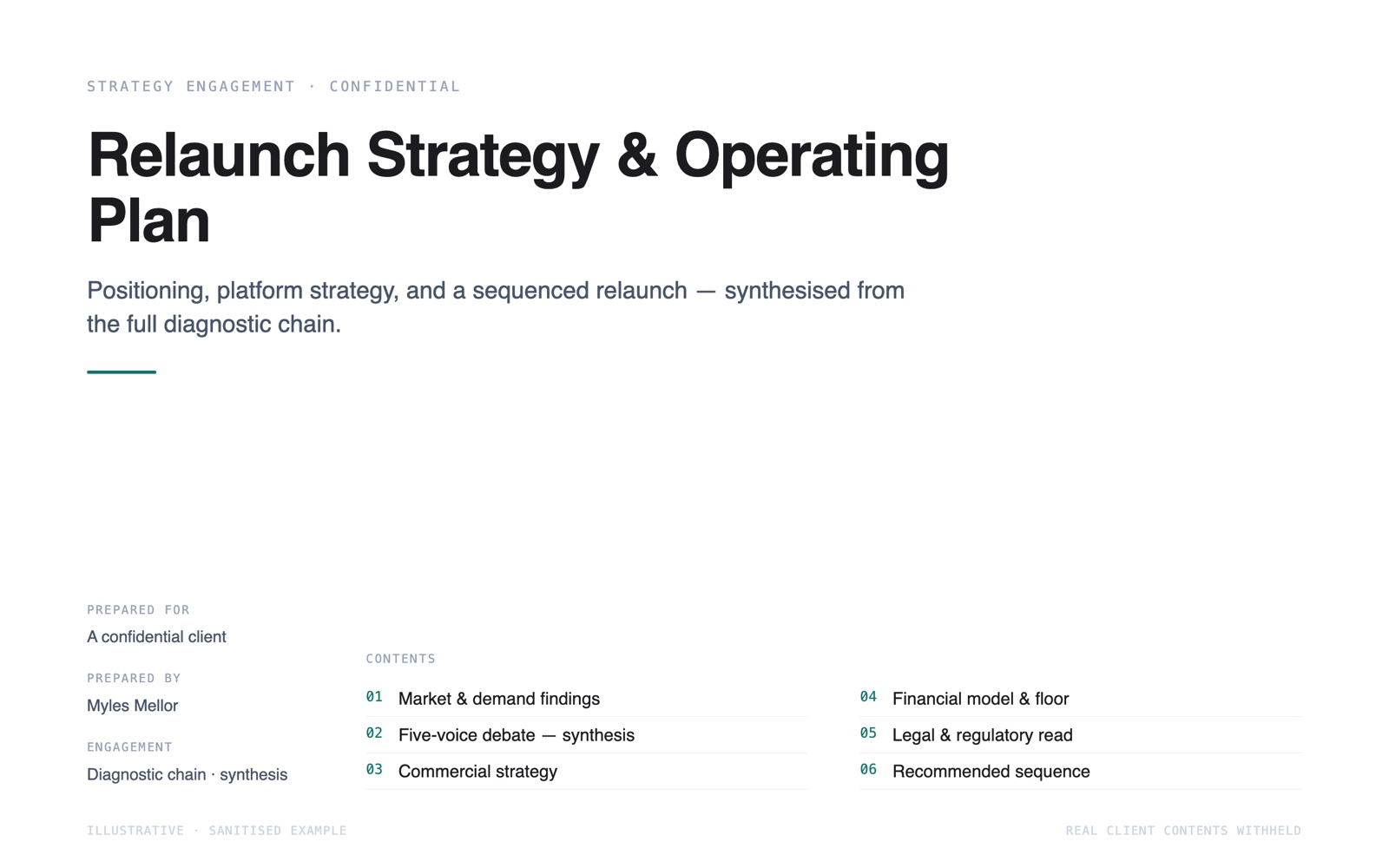
Run end-to-end, the pipeline generated a full set of working artefacts — each a real file, each building on the last:
- an intake brief capturing the situation in the founder's own framing;
- a research dossier grounding the market and platform questions in cited evidence — extended with a take-away prompt run through a second AI tool and triangulated where the stakes were highest;
- a five-voice debate that stress-tested the idea from feasibility, risk, buyer, precedent, and lateral angles — the buyer voice's veto did real work here;
- three specialist reviews — commercial strategy, a financial model, and a legal and regulatory read;
- a strategy synthesis that held those tensions together into a relaunch plan, plus a one-page operator sheet the founder could carry day to day.
What didn't happen matters as much: nothing was decided by the machine. Every output was a draft we worked over together, and the final calls were the founder's.
What stays private
The artefacts above exist; their contents don't appear here and never will. That boundary is the same one I design into every system — the thing worth showing is the method and the judgement, not someone else's confidential material. A capability surface shouldn't cost a client their privacy to exist.
Why it matters
This is the chain doing the job it was built for, on a real problem with a real person on the other side. The proof isn't a polished deck — it's that a messy, high-stakes decision got argued thoroughly from every angle, grounded in evidence, and then handed back to the person whose call it actually was.