Live since October 2026 · search visibility still very low
Setting this site up to be found locally
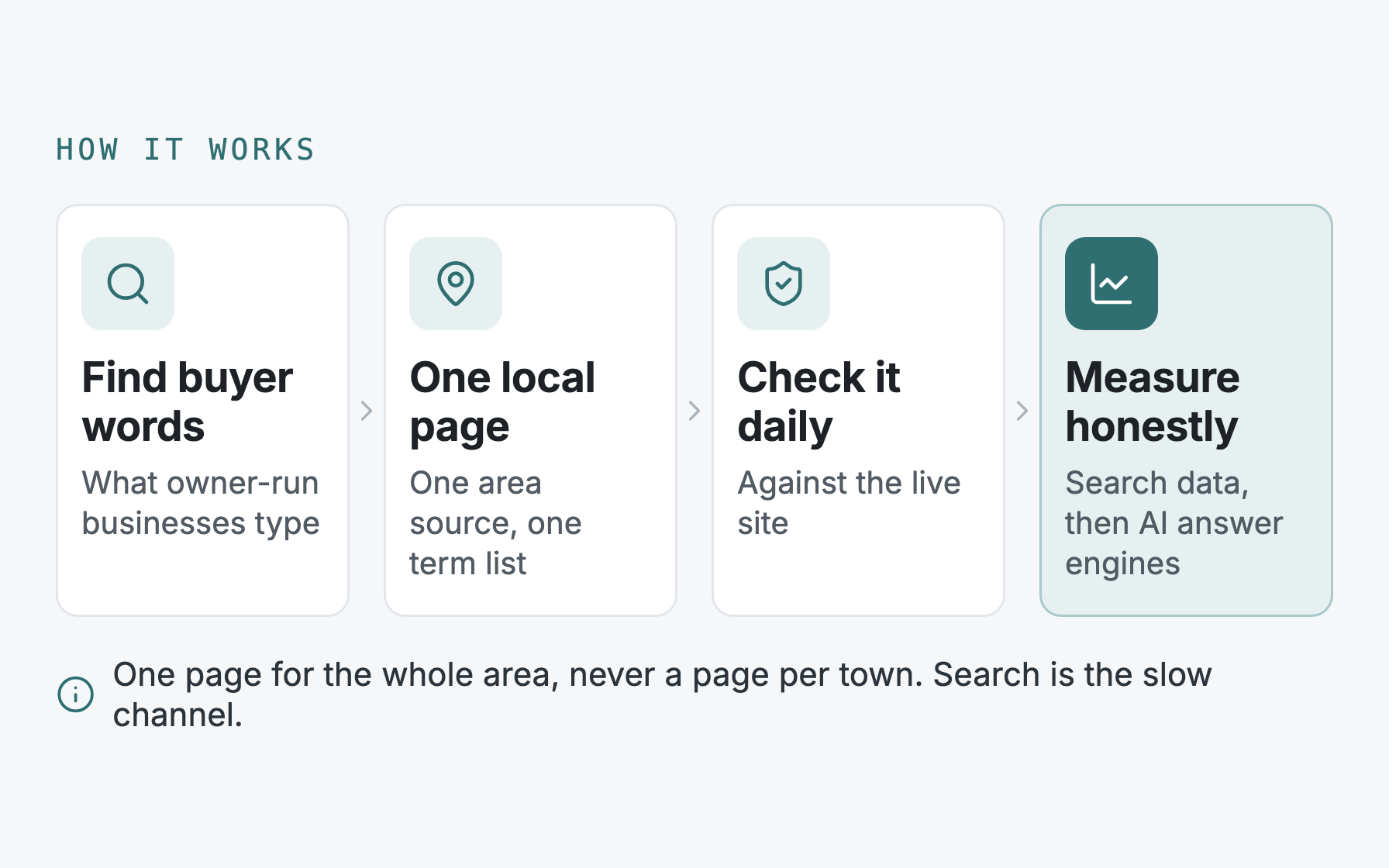
One local page instead of a page per town, one list of search terms each owned by a page, and an automated check on what the live site serves. The honest result so far: search barely finds it yet.
This site does its job when someone is sent to it. What it did not do was get found. In mid-October I pulled 90 days of Google's data for it: about 250 appearances in search and 4 clicks. Every search it appeared for was about my build write-ups or my own name. It never appeared once for anyone looking for help with AI, and the services and enquiry pages had never been shown at all.
The reason was plain once I looked. The site never used the words "AI consultant" anywhere. It described the work in terms nobody types into a search box.
The decisions
One local page, not a page per town. Searches like "AI consultant Derbyshire" are rare; Google suggests nothing for them. What ranks for them now is mostly template pages from firms elsewhere, with the town name swapped in. Search engines treat those as doorway pages, and they say nothing true about the area. So there is one page for the whole area, listing the problems I help with and linking to real work.
Use the label buyers use, once. "AI consultant" now appears in page titles and once in the body copy. Everywhere else the writing stays as it was.
One source for where I work. The area (Derbyshire, South Yorkshire, the East Midlands, and remotely anywhere in the UK) is written down in one file. The structured data search engines read, the local page and the footer all take it from there. If the area changes, it changes in one place and cannot drift between pages.
One list of target terms. Every term I want to be found for sits in a single list, with a tier and the page that owns it. There are 22 terms at the moment. A term with no page is marked as a gap, and new pages come only from that list, one at a time, each backed by real work. Job-seeker searches ("AI consultant salary", "course") are deliberately left off.
The automated check
Search set-up fails quietly. On the sauna directory I run, a hosting setting overrode the site's main address for five months and nothing complained. So this site has a contract: a script that asks the live site what it actually serves and checks it against a written list of rules. It checks the main address and redirects, the sitemap, the robots file, the "not found" page, the preview details shown when a page is shared, the structured data on each key page, and that the analytics tag has not crept back in unguarded.
It runs every morning on GitHub against the live site. Before it runs, a self-test plants known faults and proves the check can still catch them, because a check that can no longer fail tells you nothing. The run today reported 293 checks passed, with one known issue that is written down rather than ignored: an old web address takes two redirects instead of one to arrive.
Measuring it
A script reads Google's search data for every term on the list and reports three things: which terms were shown, which have no page yet, and new searches worth adding. The plan is to run it at each weekly review and log the result. Once a month I ask the AI answer engines, such as ChatGPT and Perplexity, four set questions, like who is a good AI consultant for a small business in Derbyshire, and note whether the site is named.
Where it is
Search visibility is still very low. By month the site has had a few clicks at most: 2 in August, 3 in September, 2 in October, 1 so far in November, from roughly 120 to 140 appearances a month. At the October baseline, none of the target terms had been shown. In the 28 days to 21 November, one of the 22 had: "AI consulting Derbyshire", shown 20 times, around position 30, with no clicks. The services page first appeared in search on 18 November, without a click. The enquiry page has still not appeared.
The technical side is sound and the local page is honest. None of that creates demand. For a new, small site, search is the slow channel; work is far more likely to come from people who are sent here. Being findable is cheap and adds up over time, but it was never going to be the pipeline, and the numbers since have confirmed it.