Used for a team meeting in Germany and a trip to Italy · shown as method only, no client or contact data
Country market maps for a valuation team
Who buys valuations in a country, who values for them now, and who to speak to. Every name is checked to be still in the job before it goes on the list.
The question was simple: in one country, who buys property valuations, who values for them now, and who should we speak to? A list of firm names answers the first part and nothing else. What makes a map usable is the second and third parts, and those are the parts that go stale.
So each map is a workbook rather than a list. It has one row per organisation that buys valuations: fund managers, listed property companies, banks, insurers, pension schemes and public bodies. Each row shows the firm that values for it now, where that is published, and a named contact. A separate tab holds dated buying signals, such as a mandate term ending or a fund being wound up. Others hold the public tenders, the rules on how long a valuer can be kept before it must rotate, and the local rules on contacting people.
How it was built
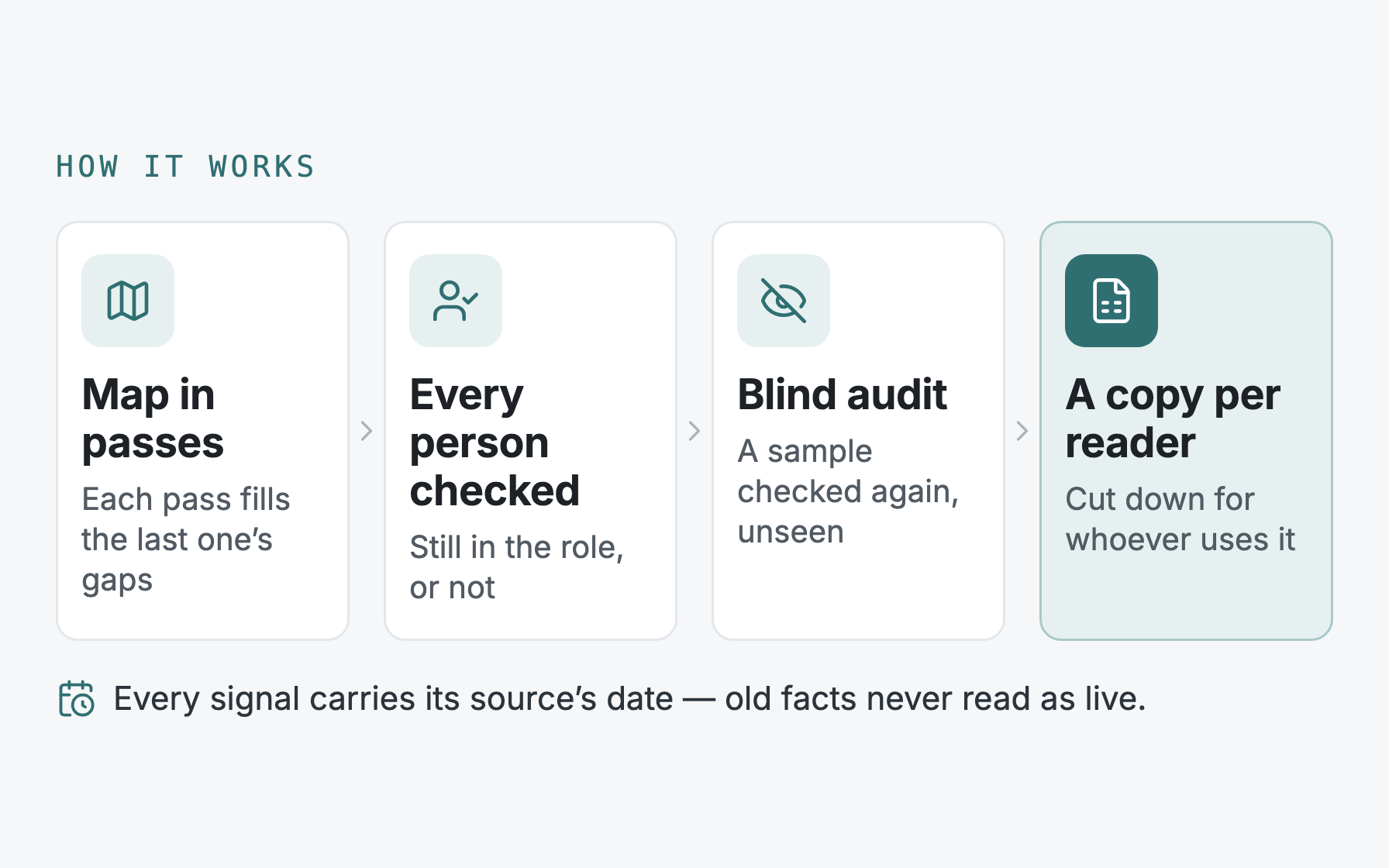
In passes, not in one go. The first pass maps the market and is honest about the gaps. Later passes fill them. Each pass is a fresh workbook, so nothing is quietly overwritten, and each pass says what it still could not find. When the search tools ran out of capacity partway through, the affected rows were marked as not researched rather than left to look empty. A blank that means "no answer exists" and a blank that means "we did not look" have to look different.
Every person is checked, not just found. Finding a name is the easy part. A researcher agent that finds a head of valuation on a two-year-old page has found someone who may have moved on. So separate agents, briefed to doubt each claim, checked every named person against a current source. Each one ends with a verdict: confirmed, confirmed with a different title, left, not found, or could not be checked. In the second map, a few people had moved on since the pages naming them were written. Those rows say so and name the successor where there is one.
A blind audit at the end. A sample of people and valuer facts went to a further check that could not see the earlier verdicts. It contradicted none of them. Where it could not reach a source, the row says that too.
Dates gate the signals. A fact found in a 2019 report is history, not a buying signal. Every signal carries the date of its source, and anything before a cut-off is marked historic and kept out of the "act now" list. Without that rule, old facts read as live ones.
The judgement calls
- Panels are not mandates. Many funds appoint a panel of valuers, or appoint a named individual rather than a firm. A "rotation due" on one of those is not an opening for a firm, and the second review of the German map rewrote its strongest signals for that reason.
- No guessed email addresses on the list. Published addresses are marked as published. Anything inferred from a firm's pattern is labelled as a guess and was never tested by sending to it.
- Contact rules come first. Each country has its own rules on cold email and calls, and the map records them so they are followed. It does not work around them. Confirming them stays with the firm's compliance team.
- A version for each reader. The working workbook is mine. The copy for a colleague drops the links, the tracker columns and the old evidence. Its overview is rewritten as research, "what is", rather than as advice. A summary written for me reads as instructions to anyone else.
What it does not do
It does not send anything or contact anyone. People are approached by the team, in their own words, through the routes the map suggests. The map makes the first conversation better informed. It does not replace the conversation.