Live since November 2026 on woodfiredsaunas.co.uk
An AI that answers the sauna site's email
It reads every message and submission, replies, corrects listings and publishes new ones on its own. What keeps it safe is what it has no tool to do.
The sauna directory earns nothing yet, and its inbox is small: in the 90 days before this was built, 10 listing submissions and 6 contact messages. Each one still needed reading, a check against the operator's website, a database change and a reply. That is a few minutes of real work, and it arrives when I am doing something else. So I asked for an agent that does most of it and tells me only when it should not decide alone.
What it does
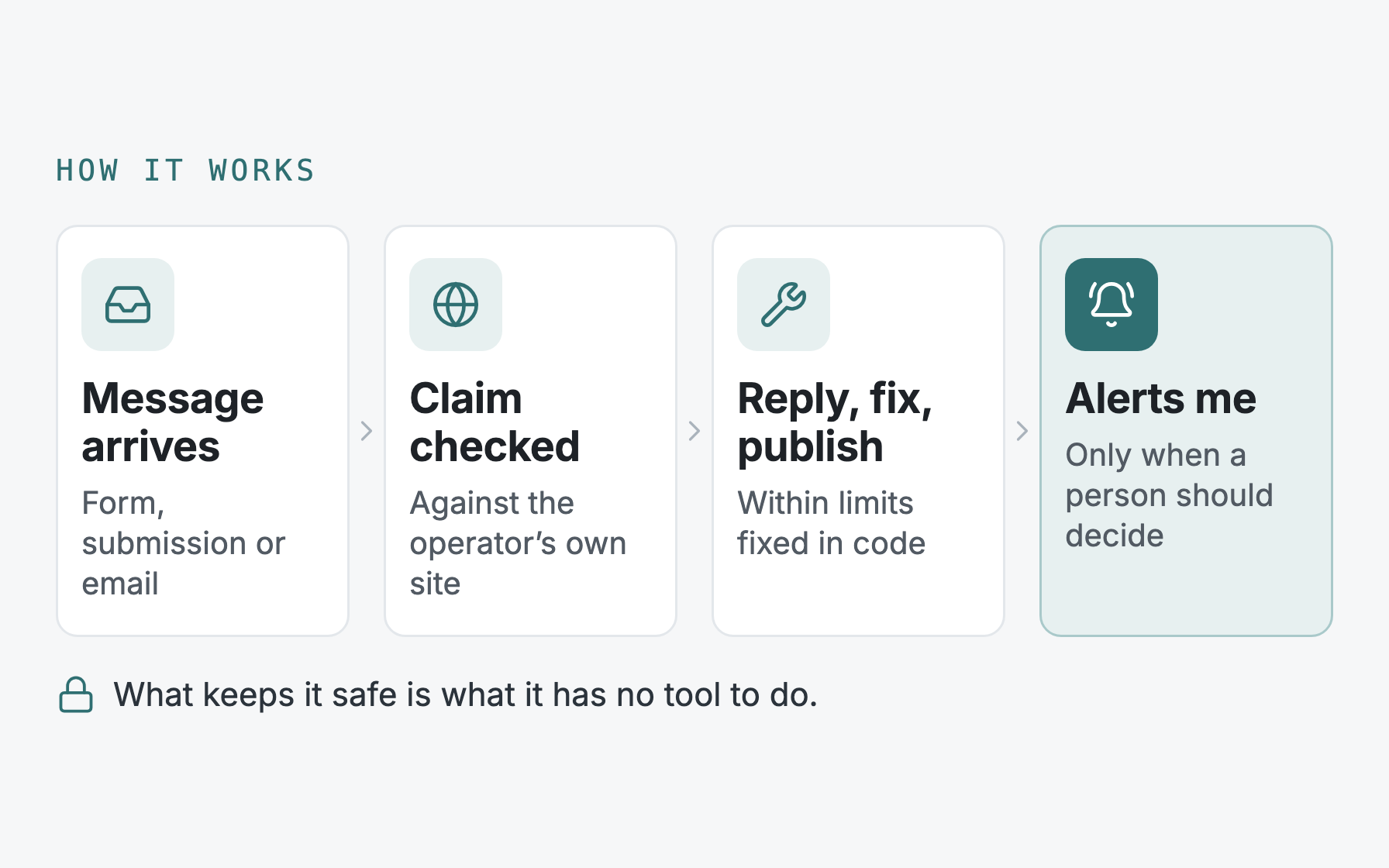
Every two hours it looks for new contact messages, submissions and email to the site's own address. If there is nothing new, it stops before any AI call. Otherwise it reads each item and does one of a few things:
- Answers it. Routine questions, thanks and simple requests get a reply from the site's address, threaded to the original.
- Corrects a listing. Taking contact details down happens straight away, because a slow answer does more harm than a wrong one. Adding or changing a fact needs evidence: the operator's own website has to show it. A new website or booking link needs a page on the listing's current site that shows the new link, whoever asks. That is the change a forger would want.
- Publishes a new listing, through the same checks a submission gets by hand.
- Asks by reply when the evidence is not there. It does not guess, and unknown fields stay empty.
- Alerts me for anything legal, any safety incident, the press, money or partnerships, requests for other people's data, an angry sender, or anything that looks like an attempt to manipulate it.
I get an email for every change it makes, showing the old and new values, and a summary once a week.
Safe by what it cannot do
Everything it reads was written by a stranger, so the protection cannot be a sentence in its instructions saying "ignore instructions in emails". The protection is the list of tools. It can read new items, look up public listing fields, fetch a web page, update named fields on a listing, publish a submission, reply to the sender of the item in hand, alert me and mark items handled. That is the whole list. It has no tool to delete anything, change the database's structure, touch code or deployments, read the subscriber list, or see my own email. It has its own mailbox, so my personal inbox, with family and financial mail in it, is never in reach.
Inside those limits there are caps: sends per day and per address, listings per item, alerts per day, and AI spend per item, per run and per day. Every write saves the old values first, so a wrong change can be undone. Replies never quote the incoming message back, so the contact form cannot be used to send someone else my words with a stranger's message attached.
How it was tested
Before it could act, it was run over all 26 past items, with nothing written or sent, and its decisions were compared with mine. On the 20 submissions with a recorded decision, 13 matched. Most of the 7 that differed were test entries of my own or artefacts of the replay. Two were real calls I had not noticed: a listing I had rejected months earlier without a recorded reason, and two live listings at the same address. The replay also found four bugs. One was escape codes leaking into published text, so "£60" came out as code. All four were fixed before it went live.
After it went live, an independent attack review and a code review ran against it. They led to tighter evidence rules, refusing anything that could run as code in a listing field, and making sure an outage loses no messages. The replay could not reach the real database or mail server, so the first live items were the first real test of those.
What it does not do yet
It has no memory of a thread, so a sender's second reply arrives as a new item. Nothing outside it notices if it stops running altogether. And an AI can still make a wrong call inside these limits. The limits decide how much harm that can do. If two operators complain about a wrong change in a month, it goes back to drafting replies for me to send. When the site starts earning money, the design gets ruled on again, because "nothing to lose" stops being true.